See exactly how
MatrixAI Studio works
A real walkthrough — from installation to a trained production model. No marketing, no mockups. Every screenshot taken from a live session.
That's it. MatrixAI runs entirely inside Docker — no additional dependencies on your machine.
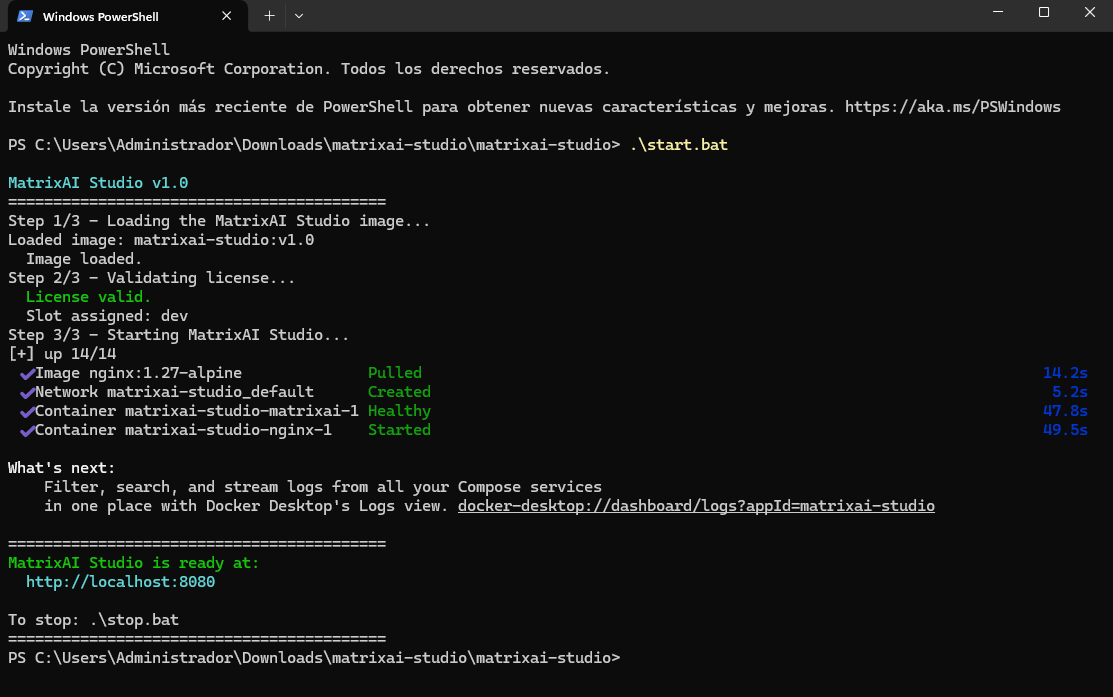
One click to launch
Run start.bat on Windows or start.sh on Mac and Linux. The script loads the Studio image, validates your licence, and starts the containers. The Studio is live at http://localhost:8080 in under a minute — no configuration needed.
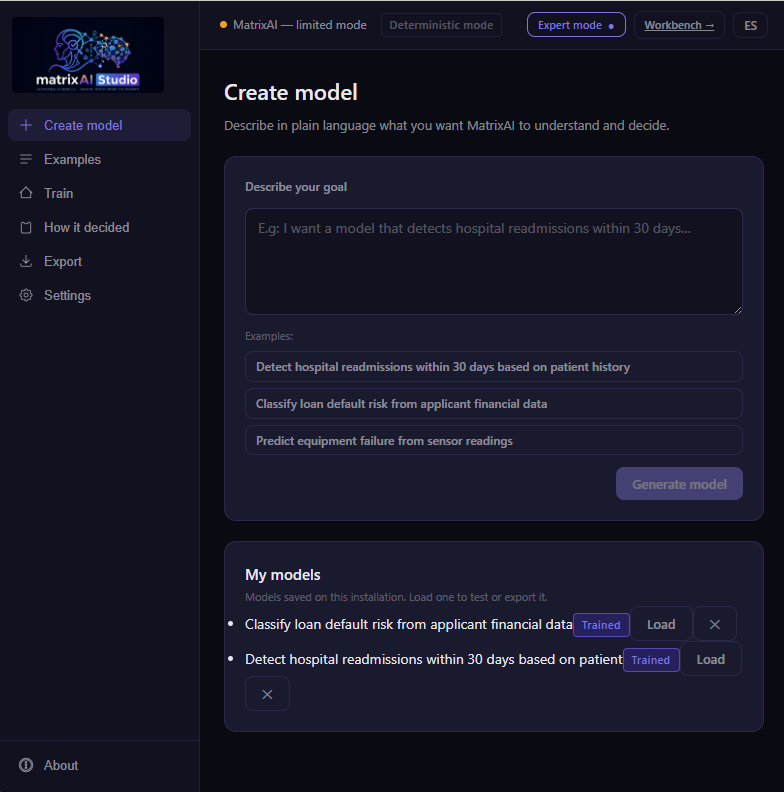
Describe your goal in plain language
Open the Studio and type what you want the model to do. No schemas, no field definitions, no code. Choose one of the suggested examples or write your own goal from scratch.
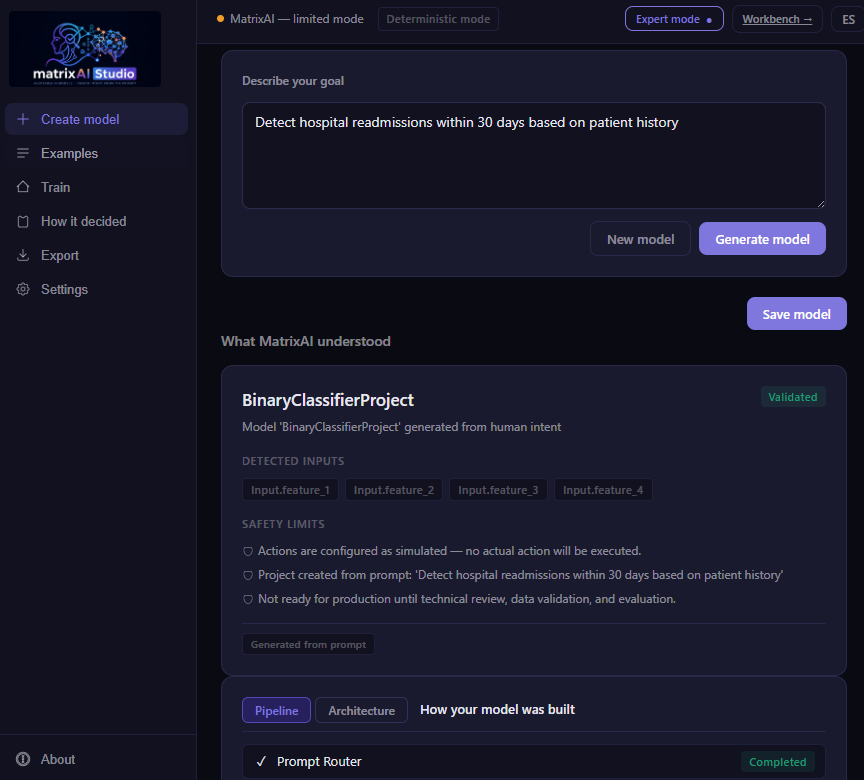
MatrixAI understands and validates
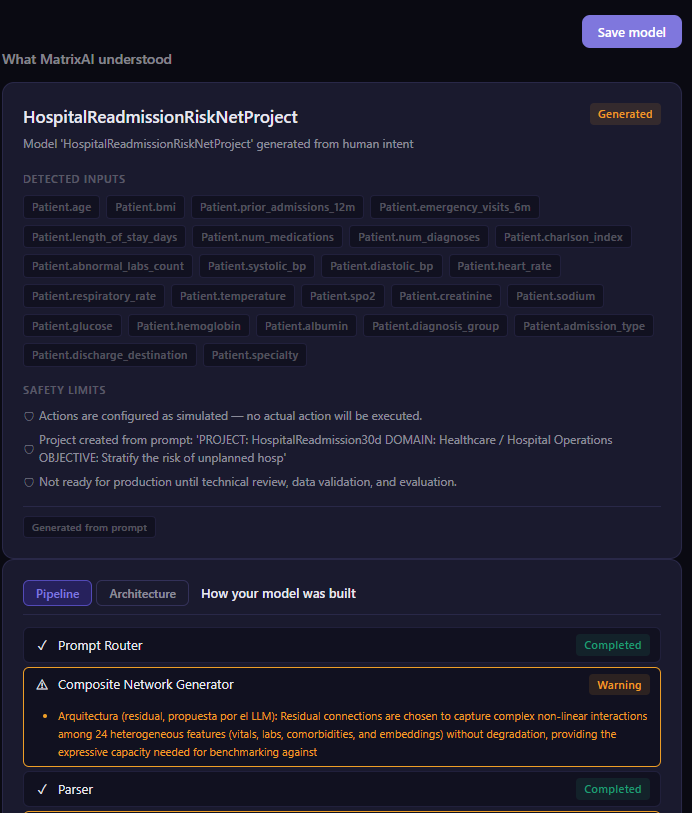
In seconds MatrixAI generates a validated model spec: it names the project, detects the input fields, applies safety limits, and marks the model Validated before a single weight is trained.
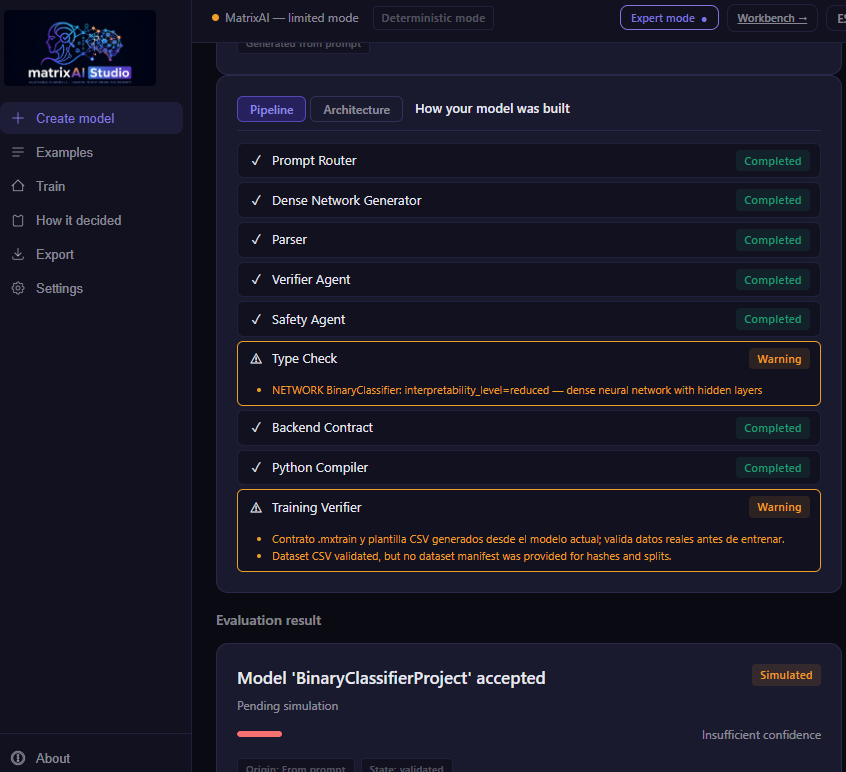
A fully visible build pipeline
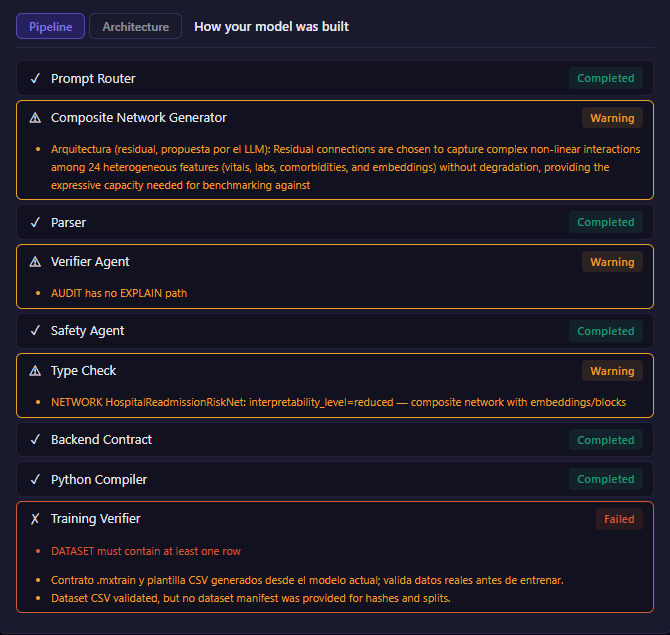
Every stage is listed with its status — Completed, Warning, or Failed. Prompt Router, Dense Network Generator, Parser, Verifier Agent, Safety Agent, Type Check, Backend Contract and Python Compiler each run in sequence. Nothing hidden behind a "thinking" spinner.
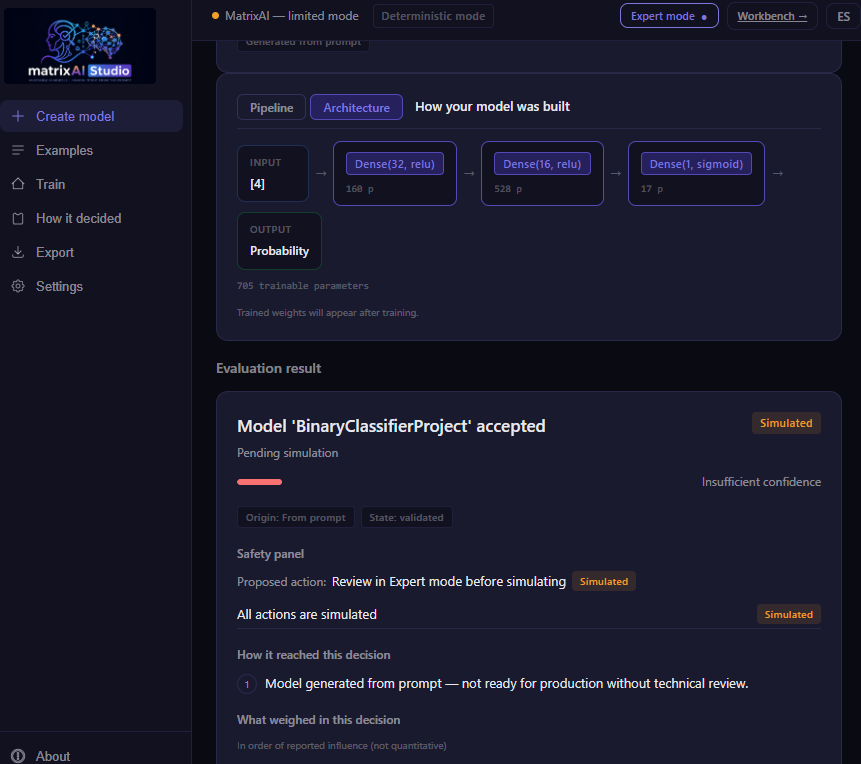
Explicit neural architecture
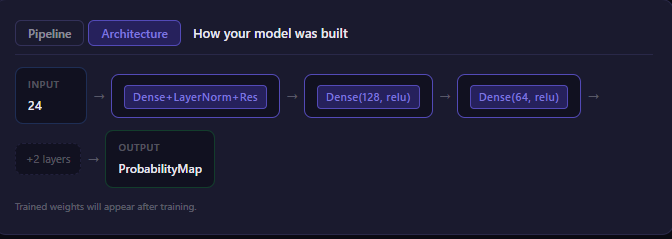
Switch to the Architecture tab to see the network as a diagram: layer types, activation functions, parameter counts. INPUT[4] → Dense(32, relu) → Dense(16, relu) → Dense(1, sigmoid) → Probability. Every tensor dimension is visible before training starts.
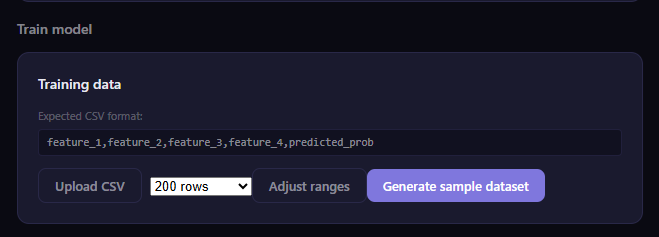
Upload your data or generate a sample
The Train section shows the exact CSV format the model expects. Upload your own file or click "Generate sample dataset" to get a ready-to-use CSV. Field types and value ranges are auto-detected and fully editable.
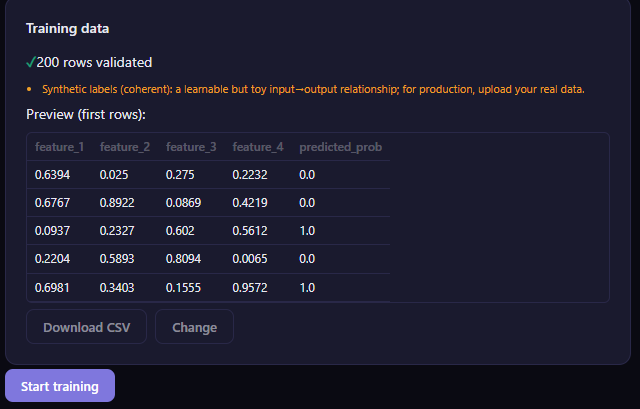
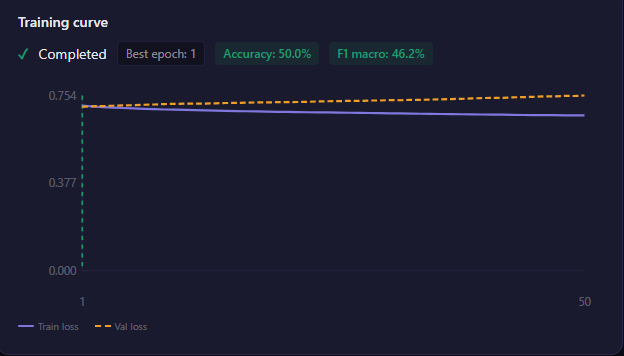
Real-time training curve
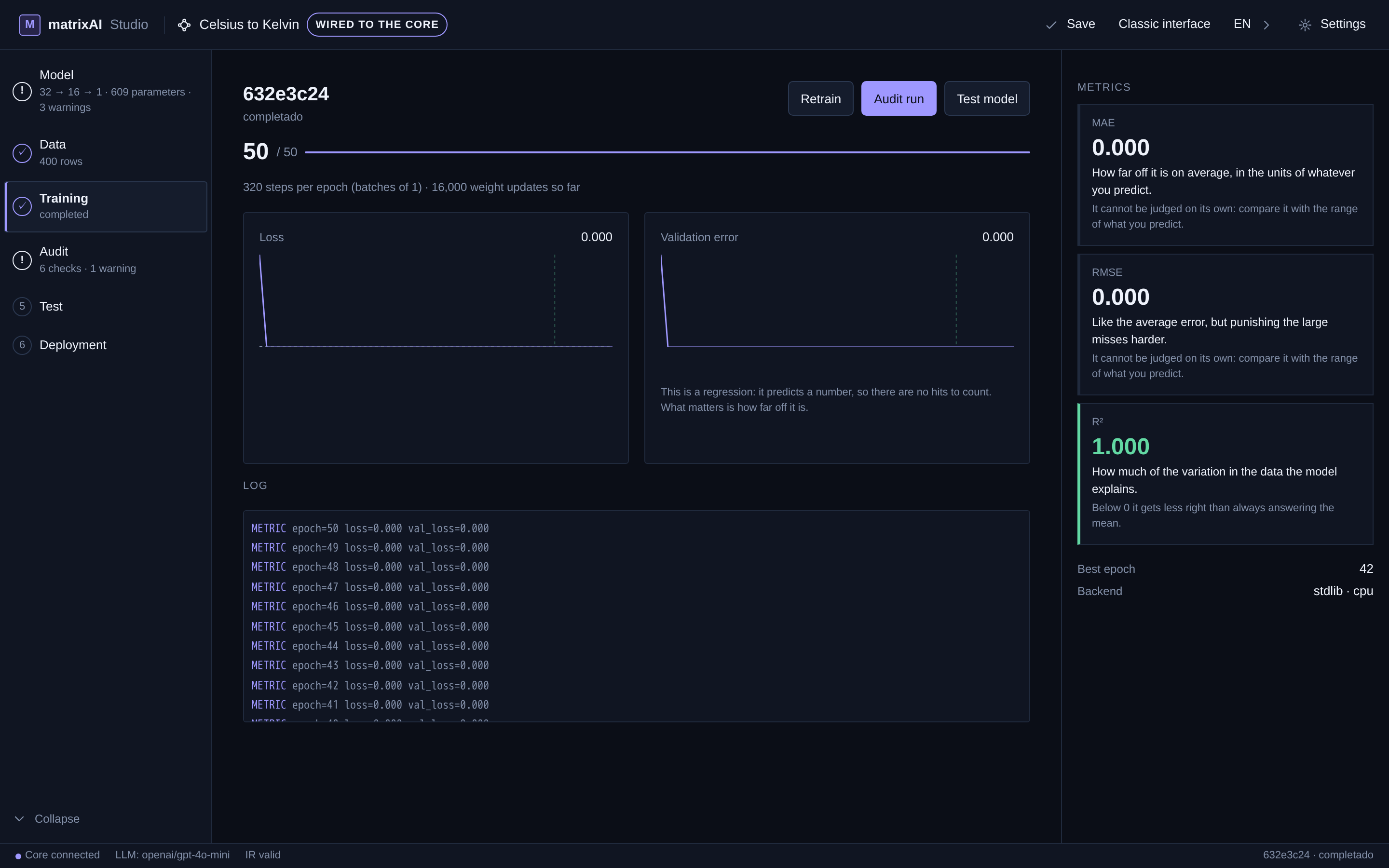
Click Start training and watch train loss and val loss update live. When training completes, the best epoch, accuracy and F1 macro score appear immediately, together with the confusion matrix for any classification model. The run below uses a synthetic sample dataset, so its accuracy says nothing about the method — what it shows is that every number is reported, including the bad ones.
Interactive prediction with sliders
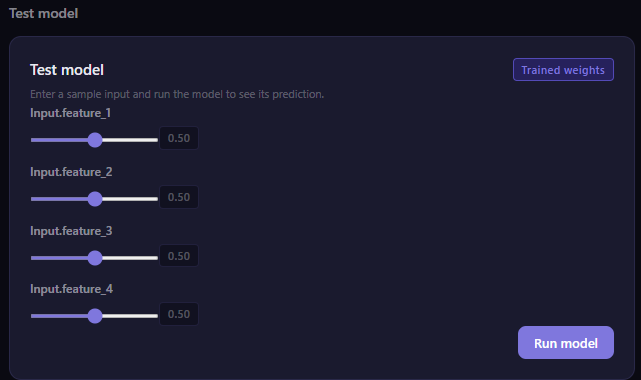
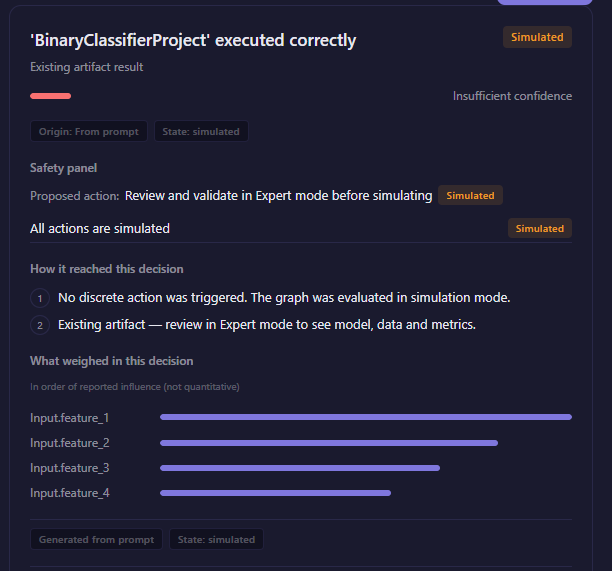
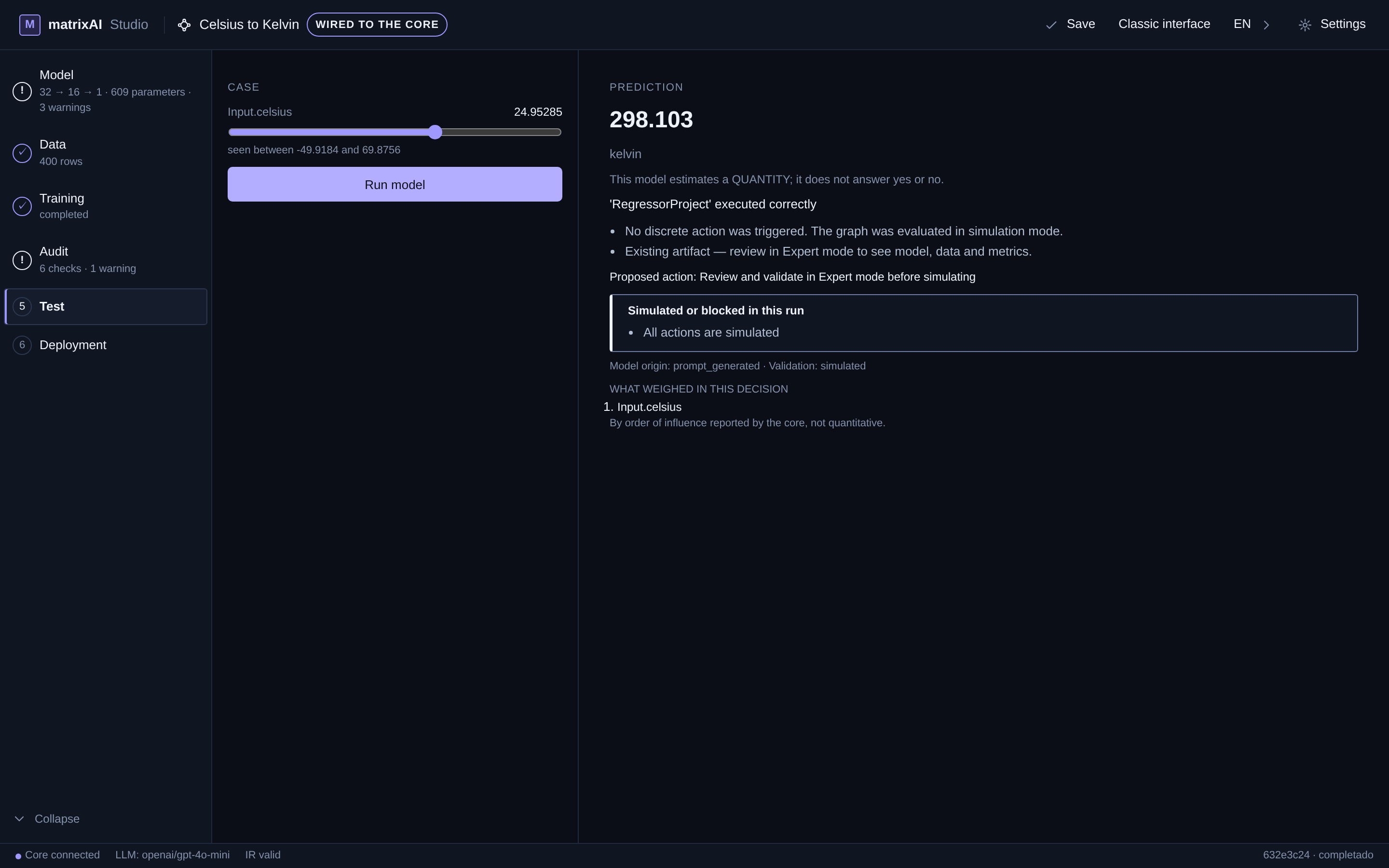
Set input values with sliders and click Run model. The result shows the classification, confidence level, the safety panel assessment, and a ranked list of which features weighed most in the decision.
Ready-to-run scenarios out of the box
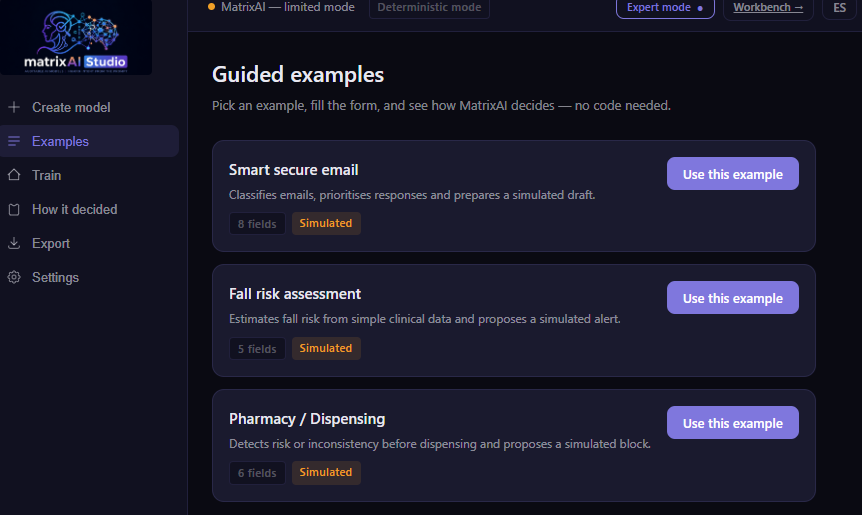
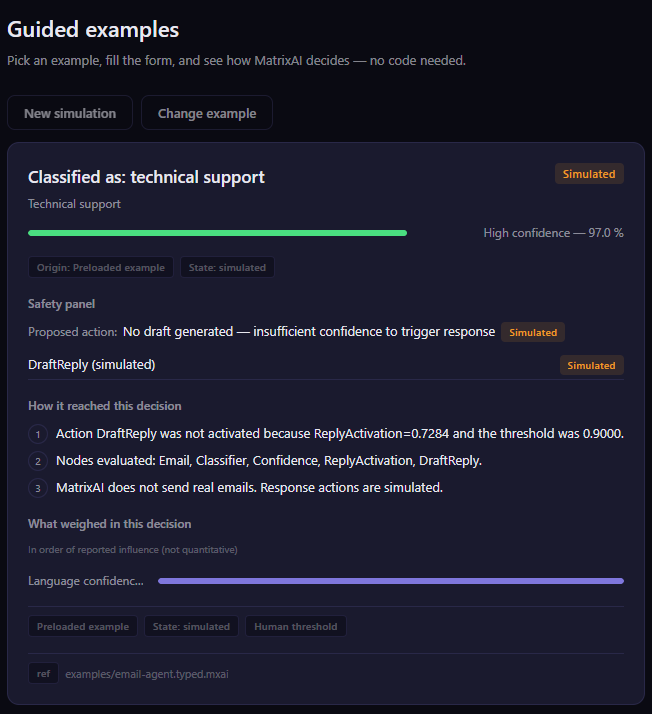
The Examples library includes pre-built scenarios: Smart secure email, Fall risk assessment, Pharmacy dispensing and more. Pick one, fill in values and see exactly how MatrixAI reaches its decision — confidence, activated nodes, what weighed in the result.
Export for production
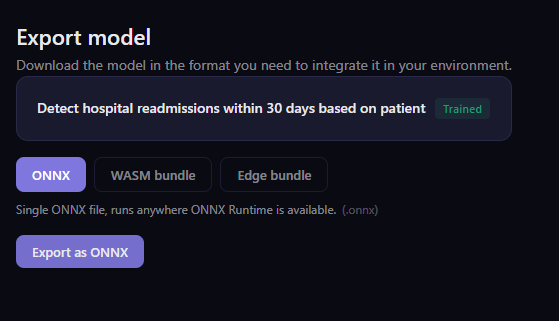
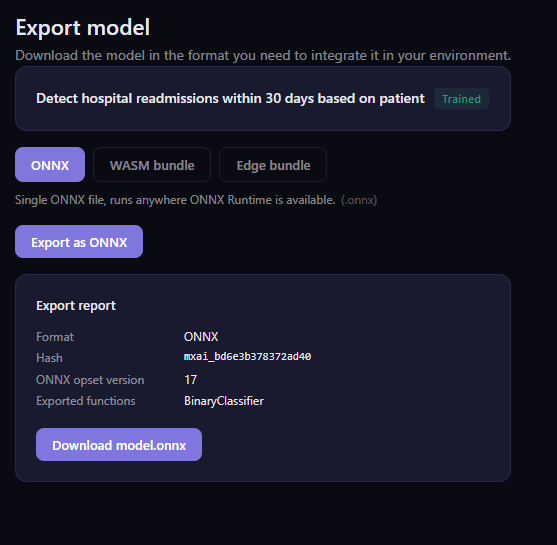
Download the trained model as an ONNX file (any ONNX runtime), a WASM bundle (runs in the browser, zero server), or an Edge bundle. Each export includes a content hash for tamper verification.
Connect your LLM for advanced architectures
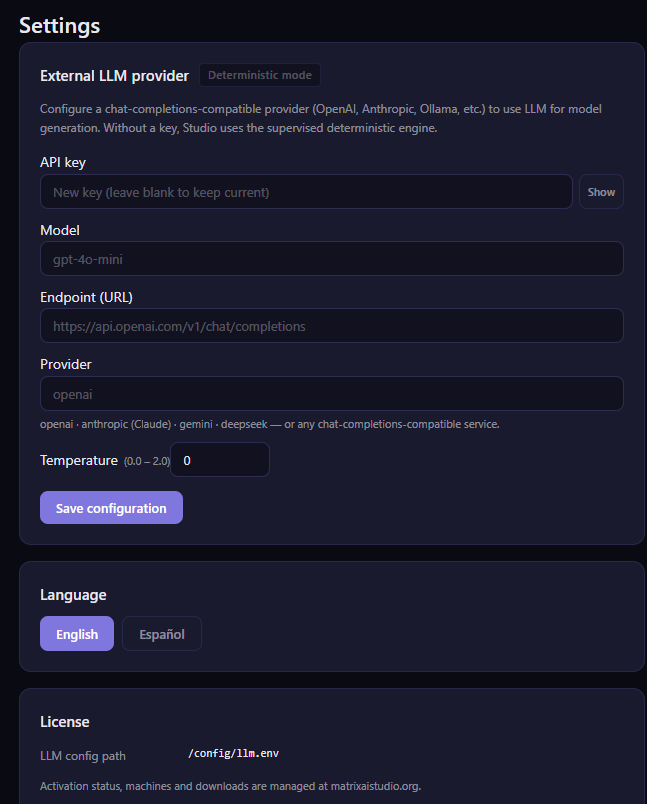
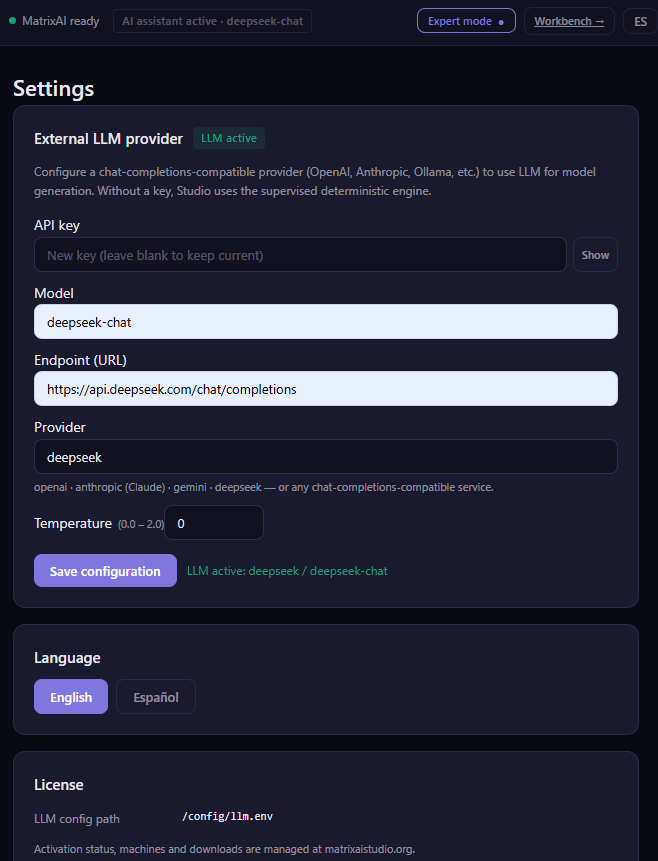
In Settings, add an API key for any chat-completions provider — OpenAI, Anthropic, DeepSeek, Gemini, Ollama or any compatible endpoint. When active, MatrixAI switches to LLM mode and can propose composite architectures for complex, heterogeneous datasets.
Complex architectures from a single prompt
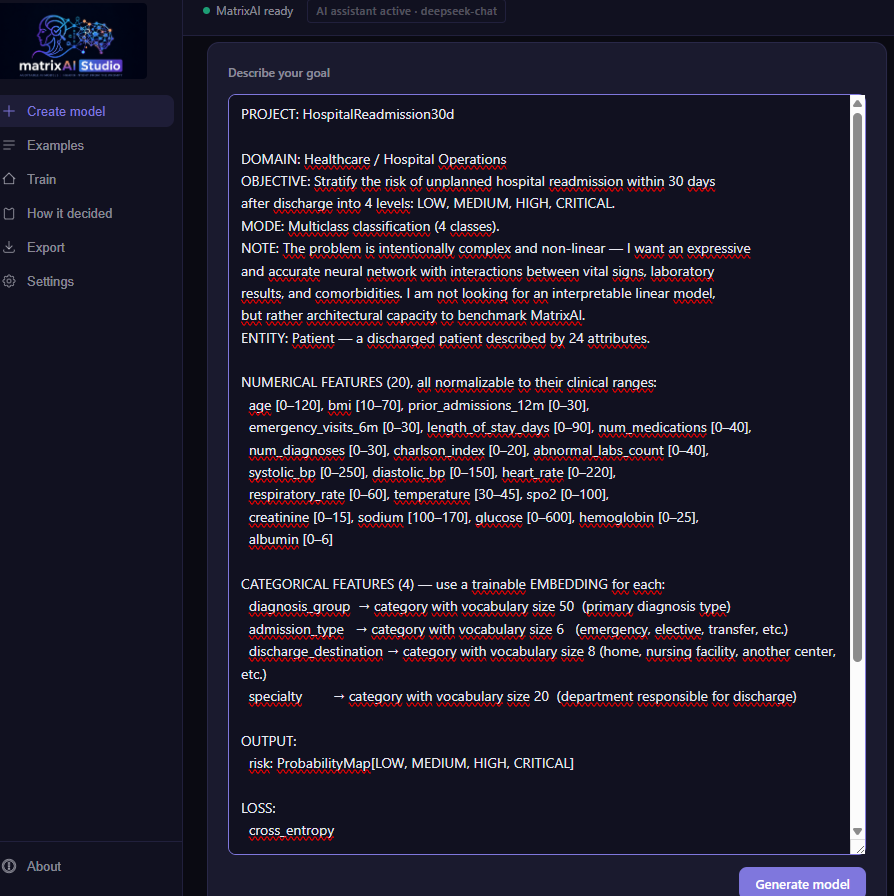
Describe a 24-feature hospital readmission model with categorical embeddings and a 4-class risk output. The LLM proposes residual connections to capture non-linear interactions across vitals, labs and comorbidities. MatrixAI enforces the safety contract on every LLM suggestion.
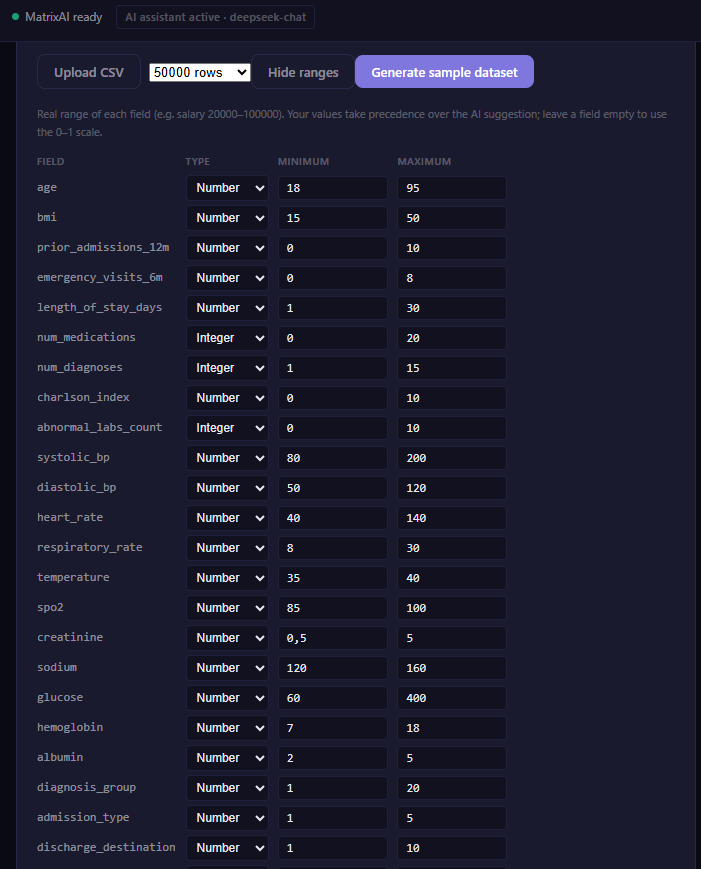
Train with 50,000 rows and clinical ranges
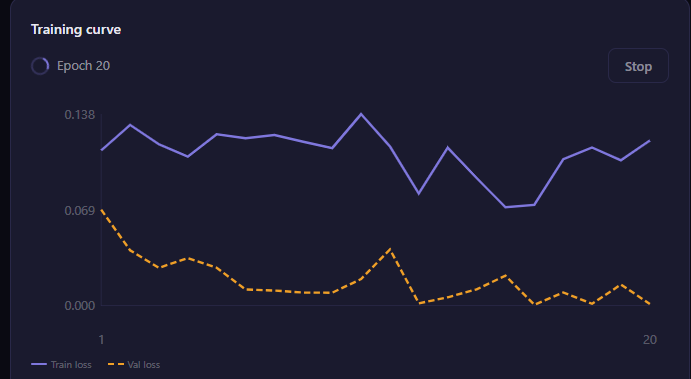
Set real clinical ranges for each field — age 18–95, systolic BP 80–200, creatinine 0.5–5 — and generate a 50,000-row dataset. Training runs epoch by epoch on the composite model, with the live curve, the epoch counter and the best checkpoint. The data here is synthetic, so the curve shows the mechanics at scale, not a clinically useful model.
The whole lifecycle, one phase at a time
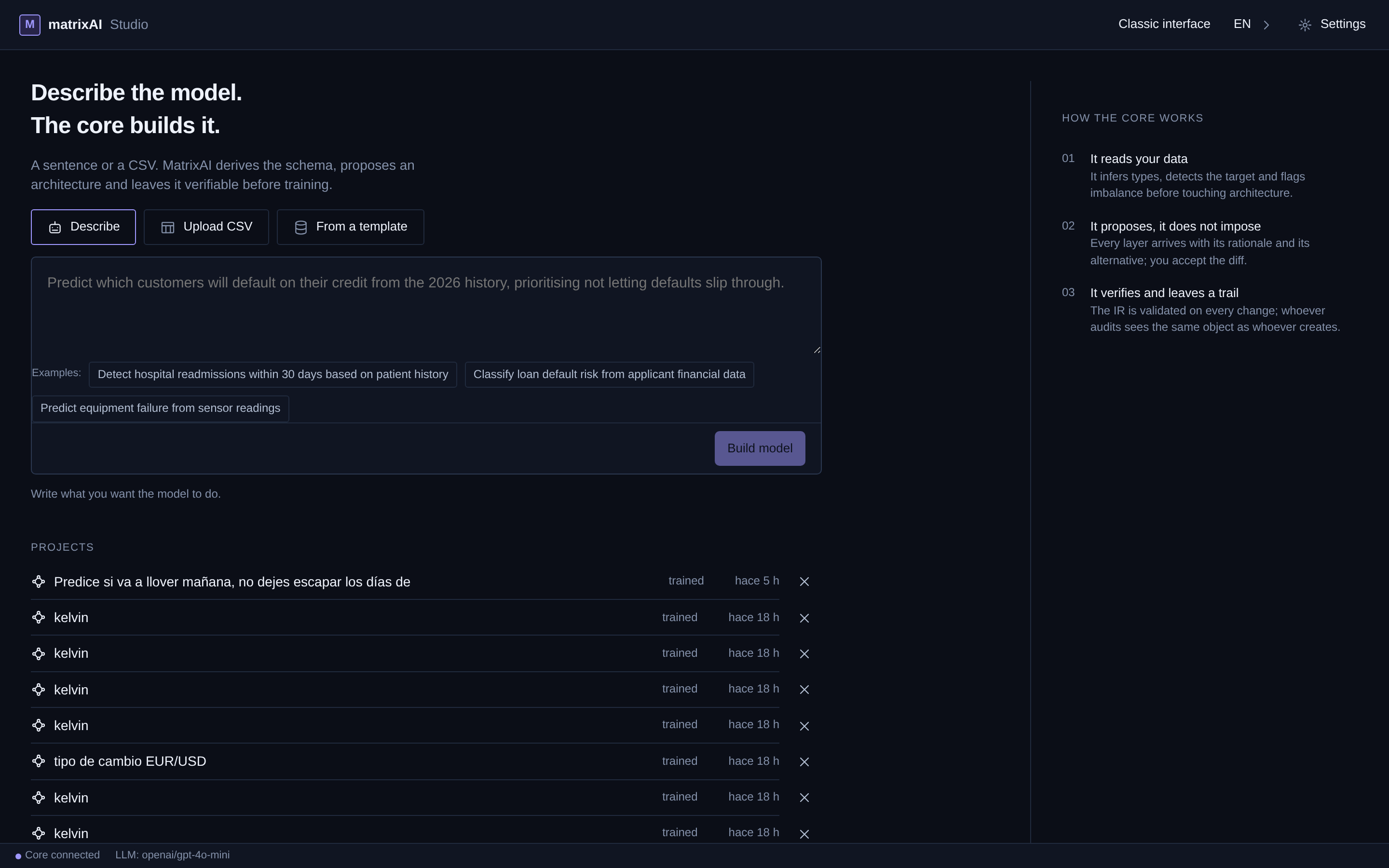
The phases interface walks the complete cycle in order — model, data, training, audit, test, deployment — and each phase says what it needs before you can move on. Start from a plain sentence, your own CSV, or a template from the catalogue.
What a template does — and what it does not
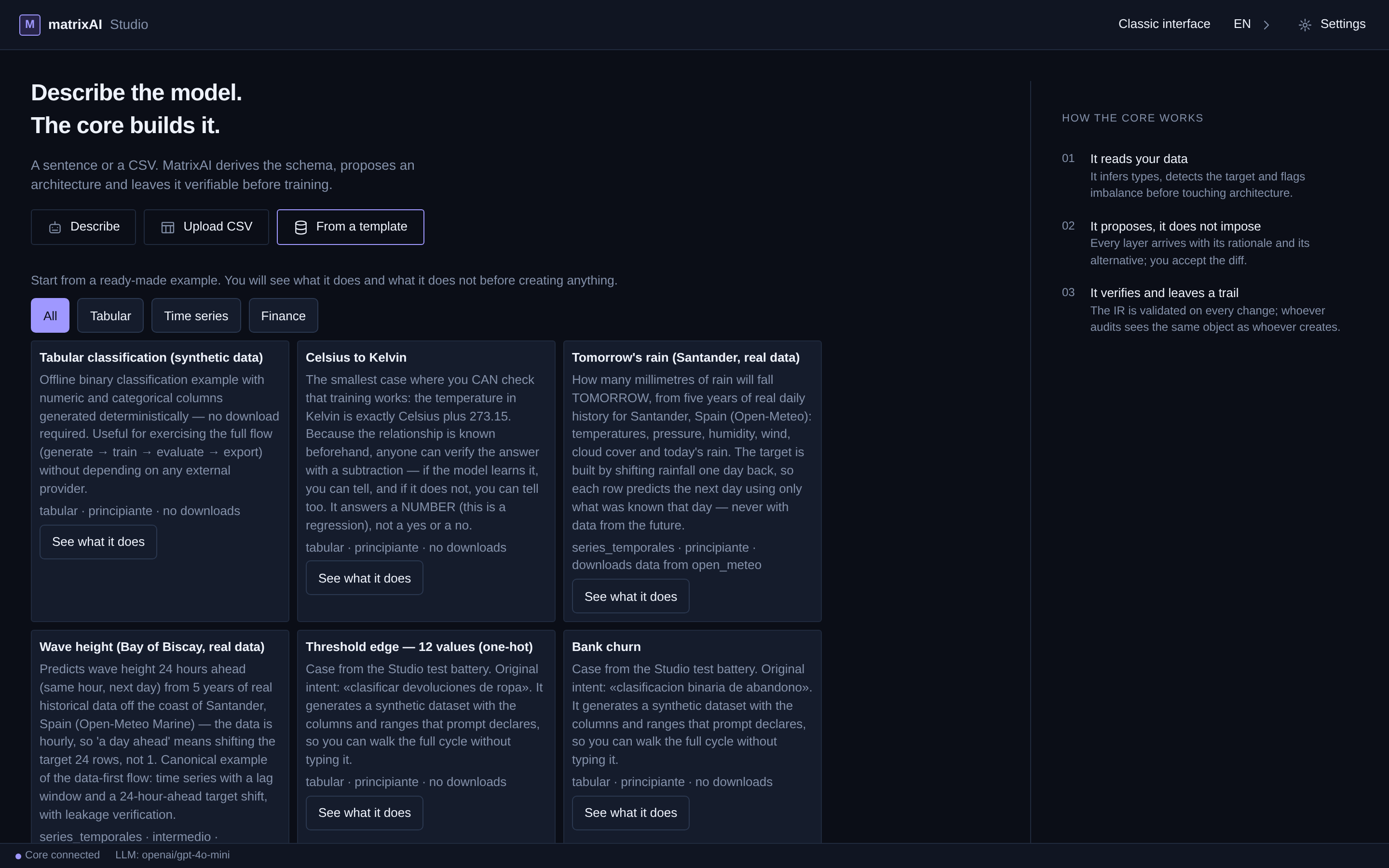
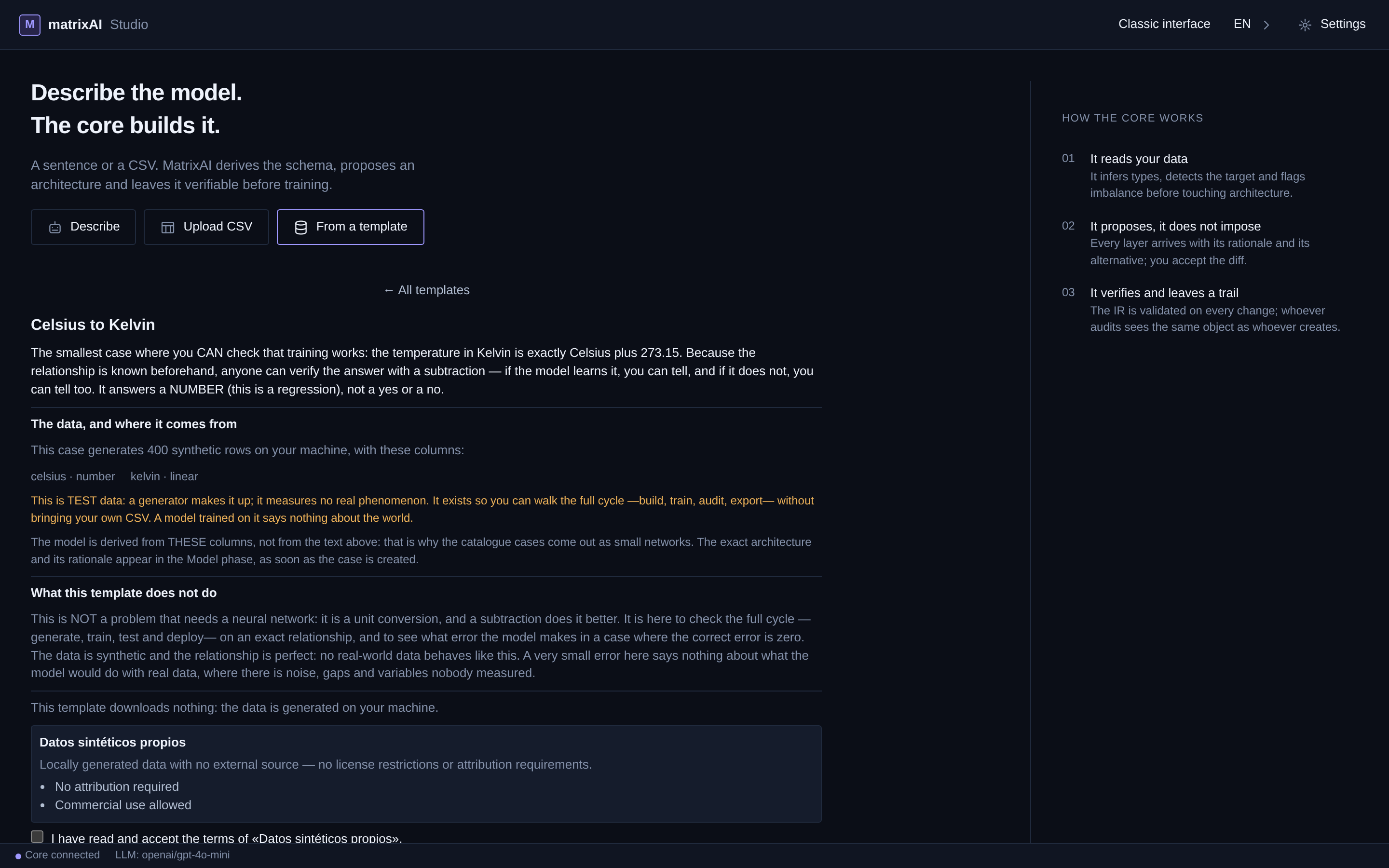
Every template states its columns, where the data comes from, its licence, and what it is NOT good for, before you create anything. The licence has to be accepted explicitly: the acceptance is recorded with the exact terms you read.
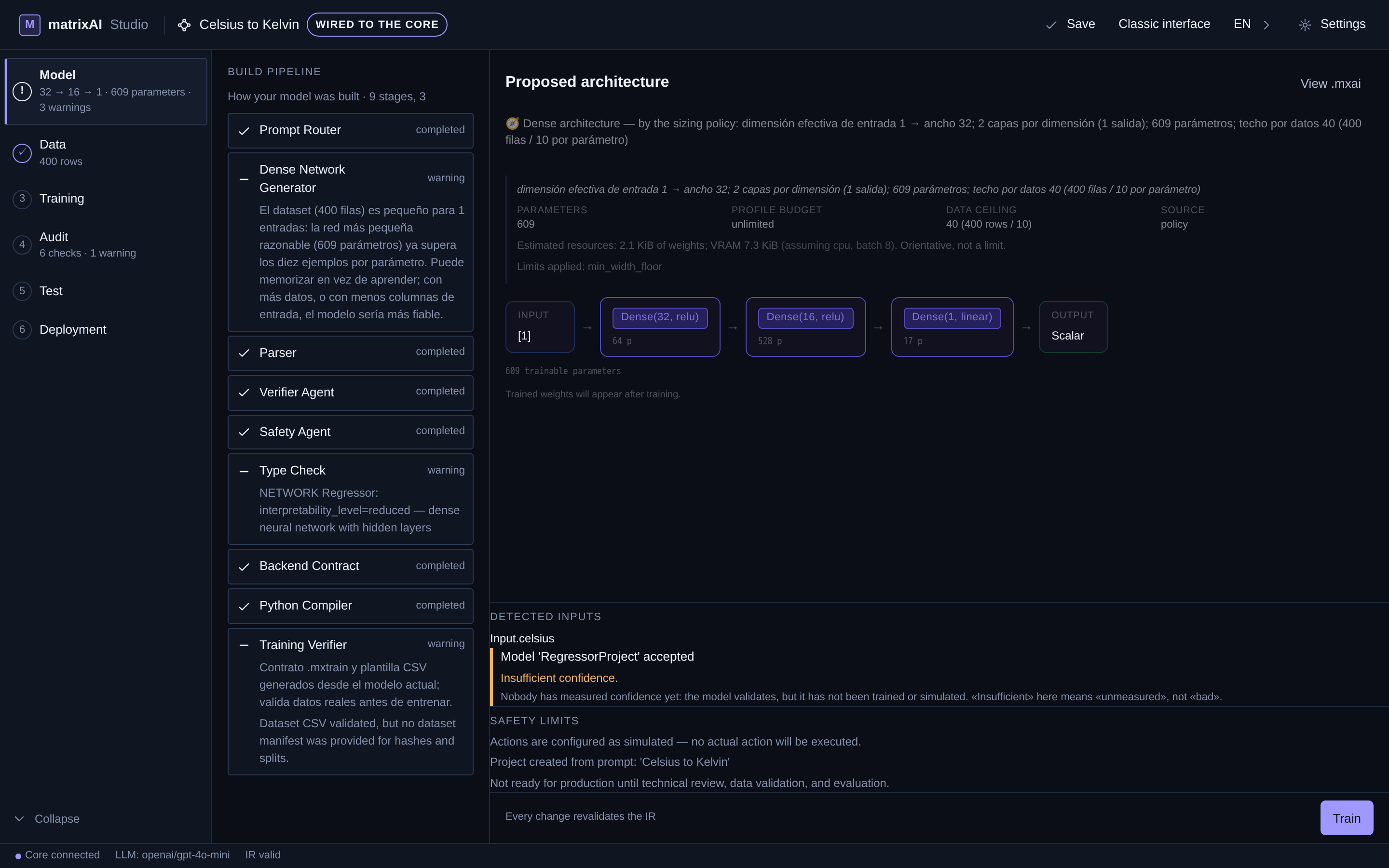
A training you can verify with a subtraction
Kelvin is exactly Celsius plus 273.15, so the correct error is zero and anyone can check the result by hand. The model reaches MAE 0.000 and R² 1.000 in 50 epochs, and predicts 298.103 for 25 °C — the exact answer is 298.15.
The full manual for the six phases — model, data, training, audit, test and deployment — screenshot by screenshot, with what each phase reports and what it says it does not do.
The rule you write so that generated rows mean something instead of being drawn at random: conditions, AND/OR, DEFAULT, declared noise, the class split you ask for, and continuous targets — line by line, with what the core reports back.
A third interface, built as a workshop: movable panels, a command palette and every view of the same model one click away. It ships in the download — the Studio opens in the phases interface and the Workbench is one click away from its settings. It is not in the public demo.
Get MatrixAI Studio
One download, one script, your instance running locally in minutes. No cloud dependency. No data leaves your machine.
Get started ↗