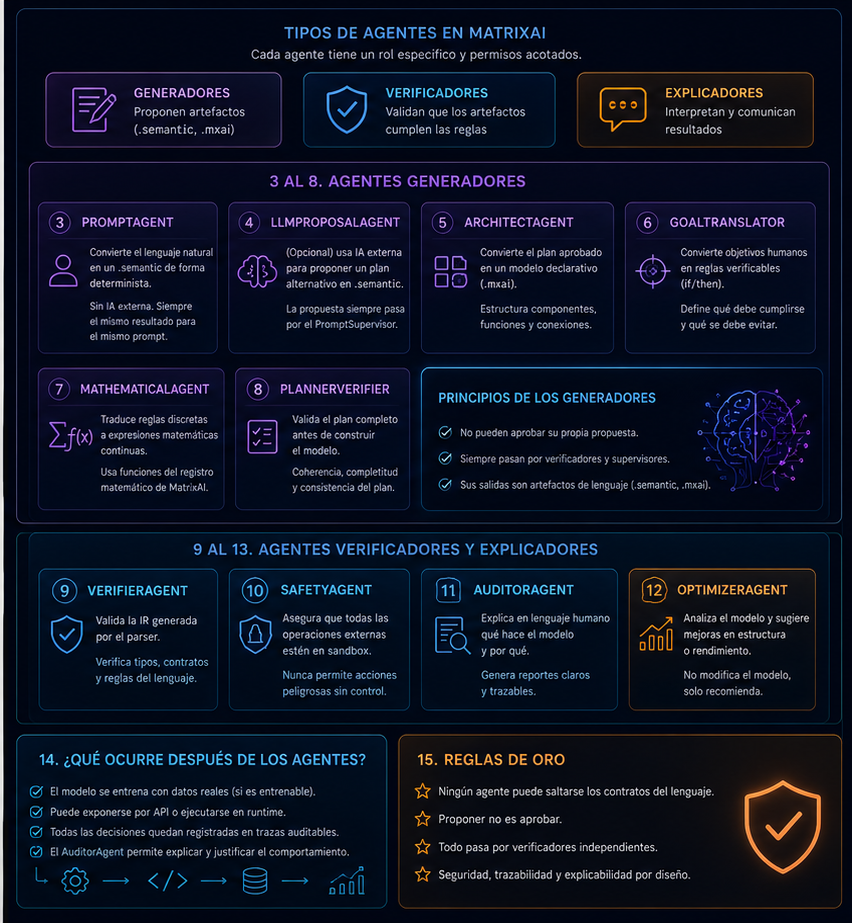
Agents — Flow & Functionality
A complete guide to the agents that run inside MatrixAI when you write a natural language description and the system generates a model. No prior knowledge of technical contracts required.

1. What is an agent in MatrixAI?
In MatrixAI, an agent is a small, specialised component that does exactly one thing. There is no large agent that controls everything: instead, several agents work in sequence, each with a specific responsibility and bounded permissions.
There are three types of agents in the system:
| Type | What it does | Examples |
|---|---|---|
| **Generators** | Propose artefacts (`.semantic`, `.mxai`) | PromptAgent`, `LLMProposalAgent`, `ArchitectAgent |
| **Verifiers** | Validate that artefacts comply with the rules | PlannerVerifier`, `VerifierAgent`, `SafetyAgent |
| **Explainers** | Interpret and communicate results | AuditorAgent`, `OptimizerAgent |
2. The complete pipeline from start to finish
When you write a prompt like "classify emails as spam, normal or urgent", MatrixAI executes this pipeline:
Human prompt
    |
PromptAgent (deterministic) or LLMProposalAgent (with external AI)
    |
.semantic — a structured draft of the model
    |
PromptSupervisor — can a real model be built from this?
    |
ArchitectAgent — converts the plan into .mxai
    |
MathematicalAgent — translates if/then rules to mathematics
    |
PlannerVerifier — validates the complete plan
    |
.mxai — the final declarative model
    |
Parser — converts .mxai to IR (internal representation)
    |
VerifierAgent — validates the IR
    |
SafetyAgent — checks no real actions exist without sandbox
    |
PythonBackendCompiler — compiles the model to executable Python
    |
Runtime / Training / API / AuditingA simple analogy
Think of building a bridge. The agents would be: PromptAgent is the architect who interprets the client's brief. ArchitectAgent draws the blueprints. MathematicalAgent does the structural calculations. PlannerVerifier and VerifierAgent are the technical inspectors who check the plans meet regulations. SafetyAgent is the safety inspection that certifies the bridge won't collapse. AuditorAgent explains to the client what decisions were made and why. No architect can approve their own blueprints.
3. PromptAgent — The deterministic entry point
File: matrixai/agents/prompt.py
The PromptAgent converts your natural language description into the first structured artefact: a .semantic file. It does this without calling any external LLM. It is completely deterministic: the same prompt always produces the same result.
What it does exactly
| Step | What happens |
|---|---|
| 1. Normalise prompt | Cleans text, detects language, identifies domain keywords |
| 2. Choose template | Selects the most appropriate template for the detected domain |
| 3. Infer the model | Extracts project, mode, entity, fields, goals and thresholds from the text |
| 4. Extract rules | Identifies "if X then Y" phrases as rules |
| 5. Emit `.semantic` | Structured file with all extracted information |
| 6. Record trace | Documents every decision made during synthesis |
Available templates
| Template | Mode | Entity | When used |
|---|---|---|---|
email | Classification | When the prompt is about emails or inbox | |
pharmacy | Risk | Order | When the prompt is about dispensing or pharmacy |
fall_risk | Risk | Patient | When the prompt is about clinical risk or falls |
generic_risk | Risk | Signal | Fallback for any unrecognised risk prompt |
generic_classification | Classification | Item | Fallback for any unrecognised classification prompt |
Example output
# Input prompt:
"A system that classifies incoming emails as urgent, normal or spam,
using the subject, sender and confidence score"

# .semantic produced:
PROJECT EmailClassifier
INTENT classify incoming emails
MODE classification
ENTITY Email
FIELDS subject, sender, confidence_score
GOAL classify_incoming_email
ACTION send_response IF urgency > 0.854. LLMProposalAgent — When an external AI is connected
File: matrixai/agents/llm_proposal.py
The LLMProposalAgent allows using an external language model to generate richer .semantic proposals adapted to complex domains.
| PromptAgent | LLMProposalAgent | |
|---|---|---|
| **Source** | Deterministic, local | External LLM (or simulated) |
| **Speed** | Instant | Depends on provider |
| **Quality in open domains** | Limited to templates | High |
| **Reproducibility** | 100% deterministic | Depends on LLM |
| **Cost** | No API cost | Consumes tokens |
| **Can approve its own proposal?** | No | No |
Available providers
| Provider | Status | Purpose |
|---|---|---|
DeterministicLLMProposalProvider | Active by default | Uses PromptAgent as offline simulation. No cost, fully reproducible. |
ChatCompletionsLLMProposalProvider | Implemented | Calls any API compatible with the HTTP chat-completions format. |
Configuration with an external LLM
MATRIXAI_LLM_API_KEY=your_api_key
MATRIXAI_LLM_MODEL=gpt-4o
MATRIXAI_LLM_ENDPOINT=https://api.openai.com/v1
MATRIXAI_LLM_PROVIDER_NAME=openai
MATRIXAI_LLM_CANDIDATES=3
MATRIXAI_LLM_TEMPERATURE=0.7
MATRIXAI_LLM_TIMEOUT=30
MATRIXAI_LLM_MAX_RETRIES=2
MATRIXAI_LLM_TOKEN_BUDGET=2000

# Or load from a .env file:
MATRIXAI_LLM_ENV_FILE=.env.llm
Call traceability
Every LLM call is recorded in an LLMCallTrace with: provider, model, endpoint, prompt hash, attempt number, latency, HTTP status, tokens consumed and error if any.
5. PromptSupervisor — The acceptance gate
File: matrixai/agents/prompt_supervisor.py
The PromptSupervisor is the most important agent in the system. Its job is one: decide whether a proposal can become a real MatrixAI model. It is completely deterministic, regardless of whether the proposal came from PromptAgent or an external LLM.
The 7 acceptance checks
Run in order. If a blocking check fails, the process stops and the proposal is rejected with a clear message.
Check 1: architect_plan
  Can ArchitectAgent convert the .semantic into a plan?

Check 2: planner_verifier
  Does the plan comply with structural and goal rules?

Check 3: mathematical_rules_resolved
  Have all if/then rules been translated to mathematical expressions?

Check 4: parser
  Can the generated .mxai be parsed to canonical IR?

Check 5: verifier_agent
  Does the IR comply with graph, action, auditing and type checks?

Check 6: safety_agent
  Do actions respect the simulate_only sandbox?

Check 7: python_compiler
  Can the Python backend compile the programme?
Response when all checks pass
{
  "accepted": true,
  "semantic_text": "...",
  "plan": {},
  "mxai": "PROGRAM EmailClassifier ...",
  "compiled_python": "...",
  "checks": [
    { "name": "architect_plan", "passed": true },
    { "name": "planner_verifier", "passed": true }
  ]
}
Response when a check fails
{
  "accepted": false,
  "checks": [
    { "name": "architect_plan", "passed": true },
    { "name": "mathematical_rules_resolved", "passed": false,
      "error": "Rule 'if priority > 0.5 or urgency > 0.8' unresolved" }
  ]
}
6. ArchitectAgent — From plan to model
File: matrixai/agents/architect.py
The ArchitectAgent takes the accepted .semantic and converts it into a structured SemanticPlan and the final .mxai file.
What it reads from the .semantic
| Block | What it extracts |
|---|---|
PROJECT | Project name |
INTENT | Model intent in text |
MODE | classification` or `risk |
ENTITY | Name of the input entity (Email, Patient, Order…) |
FIELDS | Fields of the input vector |
GOAL | Business objectives (passed to GoalTranslator) |
RULES | Conditional rules (passed to MathematicalAgent) |
CONSTRAINT | Model constraints |
ACTION_THRESHOLD | Threshold for triggering actions |
ACTION | Actions the model can execute |
What it generates per mode
| Mode | Generated structure |
|---|---|
classification | Input vector → `softmax_linear` expression → `Categorical` distribution → simulated action → audit block |
risk | Input vector → `sigmoid_linear` expression → `Normal` distribution → simulated action → audit block |
7. GoalTranslator — From human goals to verifiable rules
File: matrixai/agents/architect.py (included in the same module)
The GoalTranslator converts business goals written in natural language (the GOAL blocks from the .semantic) into concrete, verifiable rules that PlannerVerifier can check.
| Human goal | Generated rule | Parameter |
|---|---|---|
minimize_false_alerts | action_threshold_min | Minimum threshold of 0.85 |
minimize_false_replies | action_threshold_min | Minimum threshold of 0.85 |
maximize_precision | action_threshold_min | Minimum threshold of 0.85 |
maximize_safety | action_threshold_min | Minimum threshold of 0.90 |
maximize_recall | action_threshold_max | Maximum threshold of 0.75 |
minimize_latency | graph_nodes_max | Maximum 6 nodes in graph |
minimize_fall_incidents | distribution_required | `Normal` distribution required |
classify_incoming_email | distribution_required | `Categorical` distribution required |
Practical example
If your prompt says "minimise false alarms", the GoalTranslator generates the rule: "the threshold for triggering any action must be ≥ 0.85". PlannerVerifier then checks the model actually has that threshold. If not, the proposal is rejected before becoming a .mxai. This is what it means for MatrixAI to be declarative in a strong sense: you describe the goals, and the system verifies the model meets them.
8. MathematicalAgent — From rules to mathematics
File: matrixai/agents/mathematical.py
The MathematicalAgent converts "if X then Y" conditional rules into continuous mathematical expressions. Discrete rules are not differentiable (they cannot be used in training) and are not auditable in the same way.
Why convert rules to mathematics?
A rule like if risk > 0.8 then alert has a sharp jump at exactly 0.8 — from "no alert" to "alert". This creates problems during training (the gradient is zero almost everywhere) and in auditing. The solution is sigmoid(20 * (risk - 0.8)): a continuous function that behaves similarly but with a smooth transition around the threshold.
| Original rule | Generated expression | Type |
|---|---|---|
if x > threshold then action | sigmoid(20 * (x - threshold)) | Soft threshold |
if x < threshold then action | sigmoid(20 * (threshold - x)) | Inverted threshold |
if a > x and b > y then action | sigmoid(a - x) * sigmoid(b - y) | Probabilistic AND |
if a > x or b > y then action | sigmoid(a-x) + sigmoid(b-y) - sigmoid(a-x)*sigmoid(b-y) | Probabilistic OR |
classify x into a, b, c | softmax([score_a, score_b, score_c]) | Multiclass |
score = 0.6 * a + 0.4 * b | Symbolic expression | Weighted sum |
aggregate a, b using mean/max/min | mean(a, b)` / `max(a, b)` / `min(a, b) | Aggregation |
normalise x to range [0, 10] | scale(x, 0, 10) | Normalisation |
pick the best of candidates | argmax(scores) | Selection |
{
  "check": "mathematical_rules_resolved",
  "passed": false,
  "error": "Rule 'if patient.history matches pattern X' unresolved — text pattern not supported"
}
9. PlannerVerifier — Validate before building
File: matrixai/agents/planner_verifier.py
The PlannerVerifier validates the SemanticPlan before the .mxai is emitted. It is the first formal verifier in the pipeline.
| Category | What it checks |
|---|---|
| Project | Valid identifier (no special characters or spaces) |
| Mode | Must be `classification` or `risk` |
| Input vector | Valid name, at least 2 fields, no duplicates, valid identifiers |
| Functions | Each has name, declared output and expression |
| Distributions | Classification → `Categorical`, Risk → `Normal` |
| Graph | Nodes and edges are coherent, no declared-but-unconnected nodes |
| Actions | In graph, `simulate_only` policy, `simulated.*` calls, threshold in [0,1] |
| Auditing | Chain starts at input vector and ends at an action |
10. VerifierAgent — Validate the built model
File: matrixai/agents/verifier.py
The VerifierAgent validates the IR (internal representation) of the already-parsed model. It works directly on the MatrixAIProgram object — after the .mxai has been parsed.
| Check | What it verifies |
|---|---|
| `GRAPH` not empty | The model has at least one node |
| Graph nodes declared | Every node mentioned in the graph is defined |
| Actions in graph | Actions are connected to the graph |
| Action operators | Only `>`, `>=`, `<`, `<=` are used |
| Action conditions | The source of each condition is declared in the input vector |
| Actions with policy | Every action has an execution policy |
| Distributions with source | Every distribution indicates where it reads its value from |
| `AUDIT EXPLAIN` in graph | The audit block is connected |
| Acyclic graph | No circular dependencies |
| P2 types | Field and expression types are consistent |
The acyclic graph check
A graph with cycles would mean circular dependencies (A depends on B, B depends on A), which would make execution infinite or undefined. MatrixAI always rejects these.
11. SafetyAgent — The security guard
File: matrixai/agents/safety.py
The SafetyAgent is the last verifier before compiling the model. Its responsibility is ensuring the model cannot execute real actions without an explicit permissions contract.
The MVP contract: simulate_only
| Rule | What it verifies |
|---|---|
| No real actions | No action can execute code outside the simulated sandbox |
| Simulated policy required | All actions must have `POLICY simulate_only` |
| Rejects external calls | Calls must be `simulated.*`, not HTTP, SQL or other external |
What if you need real actions?
Real actions require: (1) an explicit .mxact contract file, (2) the --allow-real-actions flag on the server, (3) the env variable MATRIXAI_ALLOW_REAL_ACTIONS=true, and (4) an HMAC signing key to trace every action. SafetyAgent only blocks accidental arrival at that flow.
Security messages
"Action 'send_email' has executor_kind=real but POLICY is not real_with_approval"
"Action 'update_db' calls 'database.write' outside the simulated.* space"
12. AuditorAgent — The human-readable explanation
File: matrixai/agents/auditor.py
The AuditorAgent does not validate or generate models. Its job is to convert the result of an execution into an explanation anyone can understand.
What it explains
- If no action was triggered: why not, what values were evaluated, which threshold was not reached
- If an action was active: what value triggered it, from which source, with which threshold
- If an action was inactive: which condition was not met and by how much
- That the execution was simulated: explicit text that no real effect occurred
- Which nodes were evaluated: the complete trace of the data through the graph
Example output
Evaluation result:

The model classified this email as "urgent" with a probability of 0.94.

Factors that influenced the classification:
- The sender score (0.95) exceeded the confidence threshold (0.85)
- The email subject activated urgency signals with intensity 0.91

Proposed action: send_priority_response
- Status: SIMULATED — no real email has been sent
- Activation threshold: 0.85
- Observed value: 0.94 (threshold exceeded)

Nodes evaluated: Email → EmailScoring → UrgencyClassifier → Categorical → Action13. OptimizerAgent — Improvement suggestions
File: matrixai/agents/optimizer.py
The OptimizerAgent analyses the model and suggests improvements. It only suggests: it does not modify the model on its own. The decision to apply or not apply an optimisation always belongs to the user.
| Type | When triggered | What it proposes |
|---|---|---|
merge_linear_activation | softmax_linear` or `sigmoid_linear` followed by `sigmoid_threshold | Merge the two operations into one |
cache_embedding | A vector has fan-out to more than two nodes | Calculate embedding once and reuse |
prune_isolated_nodes | Nodes declared outside `GRAPH` | Remove unconnected nodes |
simplify_graph | Graph has more than 7 nodes | Review unnecessary intermediate nodes |
annotate_expression | A function with `kind == "unknown"` | Expression not recognised; add annotation |
review_fan_in | A node receives input from 3+ nodes | Review if high convergence is intentional |
Example report
OptimizationReport for EmailClassifier:

[SUGGESTION] merge_linear_activation
  Node: UrgencyClassifier -> sigmoid_threshold
  softmax_linear + sigmoid_threshold can be merged
  Expected impact: ~15% reduction in inference time

[SUGGESTION] simplify_graph
  Current nodes: 9 (recommended maximum: 7)
  Review whether 'IntermediateScore' and 'NormalizedScore' can be merged

No changes applied. All suggestions are informative.
14. What happens after the agents
Once PromptSupervisor accepts the proposal, the .mxai moves to the next layer. The agents are no longer present — their work is done.
.mxai accepted
    |
Interpreted runtime — runs the model without compiling, for quick tests
    |
PythonBackendCompiler — compiles to pure Python for autonomous execution
    |
DifferentiablePythonCompiler — trainable version of the model
    |
BackendContractAnalyzer — analyses portability to different backends
    |
Training (P4/P5) — adjusts parameters from real data
    |
HTTP Server (P6) — serves the model as REST API
    |
Studio (P6.5) — visual interface to explore the model15. Quick reference
| Agent | Type | Input | Output | Deterministic |
|---|---|---|---|---|
PromptAgent | Generator | Free text | `.semantic` + trace | Yes |
LLMProposalAgent | Generator | Free text | `.semantic` (proposal) | Depends on LLM |
PromptSupervisor | Gate | Prompt / `.semantic` | SupervisionReport | Always yes |
ArchitectAgent | Generator | .semantic | SemanticPlan` + `.mxai | Yes |
GoalTranslator | Translator | Goals in text | VerificationRule | Yes |
MathematicalAgent | Translator | if/then rules | Math expressions | Yes |
PlannerVerifier | Verifier | SemanticPlan | PlanVerificationResult | Yes |
VerifierAgent | Verifier | `MatrixAIProgram` (IR) | VerificationResult | Yes |
SafetyAgent | Verifier | MatrixAIProgram | Security errors/warnings | Yes |
AuditorAgent | Explainer | Runtime result | Human-readable text | Yes |
OptimizerAgent | Explainer | MatrixAIProgram | OptimizationReport | Yes |
The 7 PromptSupervisor checks
| # | Check | Blocks if fails |
|---|---|---|
| 1 | architect_plan | `.semantic` cannot become a plan |
| 2 | planner_verifier | Plan fails structural or goal rules |
| 3 | mathematical_rules_resolved | if/then rules remain untranslated |
| 4 | parser | `.mxai` has syntax errors |
| 5 | verifier_agent | IR fails graph, type or action contracts |
| 6 | safety_agent | Actions don't respect simulate_only sandbox |
| 7 | python_compiler | Model cannot be compiled to Python |
Environment variables for external LLM
| Variable | What it controls |
|---|---|
MATRIXAI_LLM_API_KEY | Provider authentication key |
MATRIXAI_LLM_MODEL | Model to use (e.g. `gpt-4o`, `claude-3-5-sonnet`) |
MATRIXAI_LLM_ENDPOINT | API base URL |
MATRIXAI_LLM_PROVIDER_NAME | Provider name (used in traces) |
MATRIXAI_LLM_CANDIDATES | Number of proposals to generate |
MATRIXAI_LLM_TEMPERATURE | Creativity (0 = deterministic, 1 = creative) |
MATRIXAI_LLM_TIMEOUT | Maximum wait time in seconds per call |
MATRIXAI_LLM_MAX_RETRIES | Retries on network failure |
MATRIXAI_LLM_TOKEN_BUDGET | Token limit per call |
MATRIXAI_LLM_ENV_FILE | Path to a .env file with the above variables |
16. Agent → CLI command → endpoint map
| Agent | Main CLI command | Studio endpoint |
|---|---|---|
PromptAgent | matrixai prompt | POST /api/analyze |
LLMProposalAgent | matrixai propose | `POST /api/analyze` (with LLM) |
PromptSupervisor | matrixai supervise-prompt | `POST /api/analyze` (auto) |
ArchitectAgent | matrixai architect | POST /api/analyze |
MathematicalAgent | matrixai mathematize | `POST /api/analyze` (internal) |
PlannerVerifier | matrixai validate-plan | `POST /api/analyze` (internal) |
VerifierAgent | matrixai validate | `POST /api/analyze` (internal) |
SafetyAgent | matrixai permissions | `POST /api/analyze` (internal) |
AuditorAgent | `matrixai run` (audited output) | POST /api/studio/run-executive |
OptimizerAgent | matrixai optimize | `POST /api/analyze` (internal) |
17. PromptAgent — CLI & API
CLI
# Basic: print the generated .mxai
matrixai prompt "classify emails as spam, normal or urgent"

# Save the .mxai
matrixai prompt "classify emails as spam, normal or urgent" -o email.mxai

# See the intermediate .semantic the PromptAgent built
matrixai prompt "classify emails as spam, normal or urgent" --semantic

# Read description from a file
cat my_description.txt | matrixai prompt - -o model.mxai

# Full JSON output (includes .semantic, .mxai, trace and checks)
matrixai prompt "classify emails as spam, normal or urgent" --json

# If the generated model isn't what you expected:
matrixai prompt "my description" --semantic -o draft.semantic
# ... edit draft.semantic ...
matrixai supervise-prompt "my description" --proposal draft.semantic
REST API (Studio — port 8080)
curl -X POST http://localhost:8080/api/analyze \
  -H "Content-Type: application/json" \
  -d '{"prompt": "classify emails as spam, normal or urgent"}'

# Response:
# { "ok": true, "semantic_text": "...", "mxai": "PROGRAM EmailClassifier ...",
#   "pipeline_stages": [
#     { "name": "prompt_agent", "ok": true },
#     { "name": "architect",    "ok": true },
#     { "name": "verifier",     "ok": true },
#     { "name": "safety",       "ok": true },
#     { "name": "compiler",     "ok": true }
#   ],
#   "supervision_source": "deterministic" }
18. LLMProposalAgent — CLI & API
Environment variables
export MATRIXAI_LLM_API_KEY=your_api_key
export MATRIXAI_LLM_MODEL=gpt-4o
export MATRIXAI_LLM_ENDPOINT=https://api.openai.com/v1
export MATRIXAI_LLM_PROVIDER_NAME=openai
export MATRIXAI_LLM_CANDIDATES=3
export MATRIXAI_LLM_TEMPERATURE=0.7
export MATRIXAI_LLM_TIMEOUT=30
export MATRIXAI_LLM_TOKEN_BUDGET=2000
CLI
# With external LLM (requires env vars)
matrixai propose "mortgage risk assessment system" \
  --provider chat-completions-compatible \
  --max-candidates 3

# Deterministic mode (uses PromptAgent as stand-in, no LLM)
matrixai propose "mortgage risk assessment system" \
  --provider deterministic \
  --max-candidates 2

# Include compiled Python in the output
matrixai propose "..." --provider chat-completions-compatible \
  --json --include-compiled
Check which mode is active
curl http://localhost:8080/api/studio/status
# { "ok": true, "llm_mode": { "active": true, "provider": "openai", "model": "gpt-4o" } }
# If "active": false → server is using DeterministicLLMProposalProvider (PromptAgent fallback)
19. PromptSupervisor — CLI & API
CLI
# Supervise a previously generated (or hand-edited) .semantic
matrixai supervise-prompt "original model description" \
  --proposal my_model.semantic

# Full supervision report with all checks
matrixai supervise-prompt "original description" \
  --proposal my_model.semantic --json

# Parse supervisor results programmatically
matrixai prompt "classify emails" --json | python3 -c "
import json, sys
data = json.load(sys.stdin)
print('Accepted:', data.get('accepted', 'N/A'))
for check in data.get('checks', []):
    state = '✓' if check['passed'] else '✗'
    print(f'  {state} {check["name"]}')
    if not check['passed']:
        print(f'    ERROR: {check.get("error", "")}')
"
REST API — reading pipeline_stages
# When a check fails, subsequent ones appear as "skipped": true
# { "ok": false, "pipeline_stages": [
#     { "name": "architect_plan",              "ok": true  },
#     { "name": "planner_verifier",            "ok": true  },
#     { "name": "mathematical_rules_resolved", "ok": false,
#       "error": "Rule 'if category matches pattern X' unresolved" },
#     { "name": "parser",          "ok": false, "skipped": true },
#     { "name": "verifier_agent",  "ok": false, "skipped": true }
#   ] }
20. ArchitectAgent — CLI & API
# Convert an existing .semantic to .mxai
matrixai architect my_model.semantic -o my_model.mxai

# Typical flow: generate .semantic first, then architect
matrixai prompt "assess patient fall risk" --semantic -o risk.semantic
matrixai architect risk.semantic -o fall_risk.mxai

# Studio: run executive on an existing .mxai
curl -X POST http://localhost:8080/api/studio/run-executive \
  -H "Content-Type: application/json" \
  -d '{
    "mxai": "PROGRAM RiskAssessment ...",
    "input_json": "{"age": 75, "balance_score": 0.3}",
    "mxai_name": "RiskAssessment"
  }'
21. MathematicalAgent — CLI & API
# Translate from a rules file
matrixai mathematize business_rules.txt

# Single rule from stdin
echo "if risk > 0.8 then alert" | matrixai mathematize -

# Multiple rules
cat << 'EOF' | matrixai mathematize -
if default_history > 0.6 then reject
if income < 15000 and debt > 0.5 then review
if credit_score > 0.7 or collateral > 100000 then approve
classify application into approved, review, rejected
EOF

# JSON output
matrixai mathematize rules.txt --json

# Expected output (example):
# if risk > 0.75 then protocol
#   -> sigmoid(20 * (risk - 0.75))   [kind: sigmoid_threshold]
#
# if age > 80 and balance < 0.4 then urgent
#   -> sigmoid(20*(age-80)) * sigmoid(20*(0.4-balance))   [kind: sigmoid_and]
22. PlannerVerifier — CLI & API
# Validate a .semantic before architecting
matrixai validate-plan my_model.semantic

# With JSON output
matrixai validate-plan my_model.semantic --json

# Full pre-generation validation flow:
matrixai prompt "my description" --semantic -o draft.semantic
matrixai validate-plan draft.semantic        # validate the plan
matrixai architect draft.semantic -o model.mxai
matrixai validate model.mxai                 # validate the final .mxai

# Parse errors programmatically:
matrixai validate-plan my_model.semantic --json | python3 -c "
import json, sys
result = json.load(sys.stdin)
if result.get('ok'):
    print('Valid plan')
else:
    for error in result.get('errors', []):   print(f'  ERROR: {error}')
    for warning in result.get('warnings', []): print(f'  WARN:  {warning}')
"
23. VerifierAgent — CLI & API
# Validate the .mxai (runs VerifierAgent on the IR)
matrixai validate email_classifier.mxai

# Lint: errors + warnings (more detailed than validate)
matrixai lint email_classifier.mxai

# Strict lint for CI/CD (fails on any warning)
matrixai lint email_classifier.mxai --strict

# View the IR the VerifierAgent validates
matrixai parse email_classifier.mxai

# Type-check (P2 type system)
matrixai typecheck email_classifier.mxai

# CI integration example:
# - name: Validate model
#   run: |
#     matrixai validate email_classifier.mxai
#     matrixai lint email_classifier.mxai --strict
# matrixai typecheck email_classifier.mxai24. SafetyAgent — CLI & API
# View model permissions and sandbox status
matrixai permissions email_classifier.mxai

# Output (safely sandboxed):
# Actions declared:
#   - send_reply
#     Policy:    simulate_only ✓
#     Call:      simulated.email.send ✓
#     Sandbox:   OK — no real permissions required

# Output (violation):
# ERROR: Action 'update_database'
#   Policy:  real_execution ✗ — requires sandbox or .mxact contract
#   Call:    database.write ✗ — outside simulated.* space

# Real actions (requires explicit contract + env var)
matrixai validate-actions contract.mxact email_classifier.mxai
matrixai dry-run-action contract.mxact email_classifier.mxai \
  --contract-name SendReply \
  --input '{"subject": "URGENT", "urgency_score": 0.92}'
matrixai execute-action contract.mxact email_classifier.mxai \
  --contract-name SendReply --allow-real-actions \
  --signing-key $MATRIXAI_ACTION_SIGNING_KEY \
  --input '{"subject": "URGENT", "urgency_score": 0.92}'
Production API — real action execution
curl -X POST http://localhost:8000/execute-action \
  -H "Authorization: Bearer $MATRIXAI_API_KEY" \
  -H "Content-Type: application/json" \
  -d '{
    "contract_name": "SendReply",
    "input_data": { "subject": "URGENT", "urgency_score": 0.92 },
    "model_hash": "mxai_20d8ce3f...",
    "parameter_set_id": "v1.0_best"
  }'
25. AuditorAgent — CLI & API
CLI
# Run the model — output already includes AuditorAgent explanation
matrixai run email_classifier.mxai \
  --params runs/v1/params.best.json \
  --input '{"subject": "URGENT: system down", "sender_score": 0.95, "body_length": 90}'

# Classification: urgent (probability: 0.94)
# Factors: sender_score (0.95) exceeded threshold 0.85
# Action: send_priority_response — SIMULATED (no real email sent)
# Nodes: Email -> EmailScoring -> UrgencyClassifier -> Categorical -> Action

# Read factors from JSON output:
matrixai run email_classifier.mxai \
  --params runs/v1/params.best.json --input input.json --json | python3 -c "
import json, sys
result = json.load(sys.stdin)
print('Result:', result.get('result'))
for factor in result.get('influential_factors', []):
    print(f'  - {factor}')
"
REST API
# Studio — executive analysis of an existing model
curl -X POST http://localhost:8080/api/studio/run-executive \
  -H "Content-Type: application/json" \
  -d '{
    "mxai": "PROGRAM EmailClassifier ...",
    "input_json": "{"subject": "URGENT: system down", "sender_score": 0.95}",
    "mxai_name": "EmailClassifier"
  }'
# Returns: { "executive_result": { "decision": "urgent", "confidence": 0.94,
#   "action_status": "SIMULATED", "explanation": "...", "influential_factors": [...] } }

# Studio — simulate a guided case
curl -X POST http://localhost:8080/api/studio/simulate \
  -H "Content-Type: application/json" \
  -d '{ "case_id": "fall-risk",
        "input_values": { "age": 78, "balance_score": 0.28, "previous_falls": 2 } }'

# Production — prediction with traceability
curl -X POST http://localhost:8000/predict \
  -H "Authorization: Bearer $MATRIXAI_API_KEY" \
  -H "Content-Type: application/json" \
  -d '{"age": 78, "balance_score": 0.28, "previous_falls": 2}'
26. OptimizerAgent — CLI & API
# View optimization suggestions for a model
matrixai optimize email_classifier.mxai

# [SUGGESTION] merge_linear_activation
#   Node: UrgencyClassifier -> sigmoid_threshold
#   softmax_linear + sigmoid_threshold can be merged
#   Expected impact: ~15% reduction in inference time
#
# [SUGGESTION] prune_isolated_nodes
#   Node: TempScore declared but not connected to GRAPH

# JSON output for scripting
matrixai optimize email_classifier.mxai --json | python3 -c "
import json, sys
data = json.load(sys.stdin)
suggestions = data.get('suggestions', [])
if not suggestions:
    print('No optimization suggestions')
else:
    for s in suggestions:
        print(f'  [{s["kind"]}] {s["description"]}')
"

# Via Studio API (suggestions appear in /api/analyze response)
curl -X POST http://localhost:8080/api/analyze \
  -H "Content-Type: application/json" \
  -d '{"mxai_text": "PROGRAM EmailClassifier ..."}'
27. Full pipeline traced with commands
Description in text
        |
        |-- CLI: matrixai prompt "description"
        |-- CLI: matrixai propose "description" --provider chat-completions-compatible
        |-- API: POST /api/analyze  { "prompt": "description" }
        |
        v
   PromptAgent / LLMProposalAgent (generates .semantic)
        |
        |-- Inspect:  matrixai prompt "..." --semantic
        |-- Edit+supervise: matrixai supervise-prompt "..." --proposal draft.semantic
        |
        v
   PromptSupervisor (check 1: architect_plan)
        v
   ArchitectAgent (generates SemanticPlan + .mxai)
        |-- Direct: matrixai architect draft.semantic -o model.mxai
        v
   MathematicalAgent (check 3: mathematical_rules_resolved)
        |-- Direct: matrixai mathematize rules.txt
        |-- stdin:  echo "if x > 0.8 then alert" | matrixai mathematize -
        v
   PlannerVerifier (check 2: planner_verifier)
        |-- Direct: matrixai validate-plan draft.semantic
        v
   Parser (check 4: parser)
        |-- Inspect IR: matrixai parse model.mxai
        v
   VerifierAgent (check 5: verifier_agent)
        |-- Direct:   matrixai validate model.mxai
        |-- Detailed: matrixai lint model.mxai
        |-- Types:    matrixai typecheck model.mxai
        v
   SafetyAgent (check 6: safety_agent)
        |-- Inspect: matrixai permissions model.mxai
        |-- Dry-run: matrixai dry-run-action contract.mxact model.mxai ...
        v
   PythonBackendCompiler (check 7: python_compiler)
        |-- Compile:      matrixai compile model.mxai -o compiled.py
        |-- Portability:  matrixai backend-report model.mxai
        v
   .mxai ACCEPTED
        |
        +-- Single run (AuditorAgent):  matrixai run model.mxai --input in.json --params p.json
        |   API production:             POST /predict
        |   API Studio:                 POST /api/studio/run-executive
        |
        +-- Optimisation (OptimizerAgent): matrixai optimize model.mxai
        |
        +-- Training:  matrixai train model.mxai --training contract.mxtrain -o runs/v1/
        |
        +-- Serving:   matrixai serve model.mxai --params runs/v1/params.best.json --api-key KEY
        |
        +-- Studio:    matrixai studio --open
28. Debug the pipeline by agent
| Failing check | What it means | How to investigate |
|---|---|---|
architect_plan | `.semantic` cannot become a plan | matrixai prompt "..." --semantic` and review the generated `.semantic |
planner_verifier | Plan has structural errors | matrixai validate-plan draft.semantic --json |
mathematical_rules_resolved | if/then rules remain untranslated | `matrixai mathematize rules.txt` to see what can be translated |
parser | `.mxai` has syntax errors | `matrixai parse model.mxai` to locate the error |
verifier_agent | IR fails contracts | `matrixai lint model.mxai --json` for all errors |
safety_agent | Actions outside sandbox | matrixai permissions model.mxai --json |
python_compiler | Model cannot compile to Python | `matrixai compile model.mxai` to see the compile error |
Full diagnostic script
#!/bin/bash
# diagnostics.sh <model.mxai>
MODEL=$1
echo "=== Pipeline diagnostics: $MODEL ==="

echo "1. Structural validation:"
matrixai validate "$MODEL" && echo "   OK" || echo "   FAIL"

echo "2. Lint (errors + warnings):"
matrixai lint "$MODEL" --json | python3 -c "
import json, sys
data = json.load(sys.stdin)
errors   = [d for d in data.get('diagnostics', []) if d.get('severity') == 'error']
warnings = [d for d in data.get('diagnostics', []) if d.get('severity') == 'warning']
print(f'   Errors: {len(errors)}, Warnings: {len(warnings)}')
for e in errors: print(f'   ERROR: {e.get("message")}')
"
echo "3. Type check:"
matrixai typecheck "$MODEL" && echo "   OK" || echo "   FAIL"

echo "4. Safety permissions:"
matrixai permissions "$MODEL" --json | python3 -c "
import json, sys; data = json.load(sys.stdin)
print(f'   Status: {data.get("safety_status", "unknown")}')
"
echo "5. Backend compatibility:"
matrixai backend-report "$MODEL" --json | python3 -c "
import json, sys; data = json.load(sys.stdin)
print(f'   differentiable_python: {data.get("compatible", "unknown")}')
for b in data.get('blocking_issues', []): print(f'   BLOCKER: {b}')
"
echo "6. Optimization suggestions:"
matrixai optimize "$MODEL" --json | python3 -c "
import json, sys; data = json.load(sys.stdin)
for s in data.get('suggestions', []): print(f'   -> {s.get("kind")}: {s.get("description")}')
" || echo "   None"
echo "=== Done ==="
# Usage:
chmod +x diagnostics.sh
./diagnostics.sh email_classifier.mxai